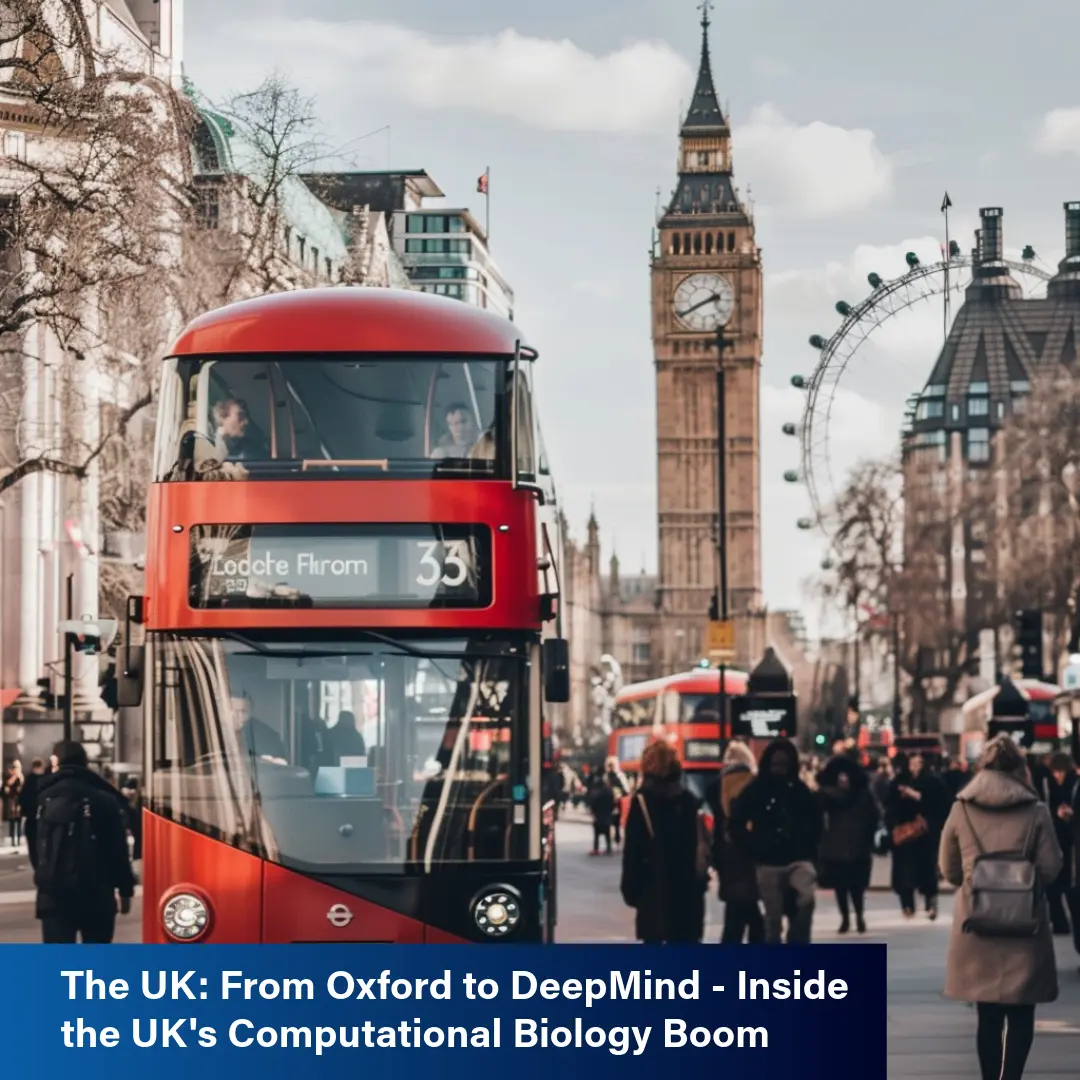
The UK: From Oxford to DeepMind ‑ Inside the UK’s Computational Biology Boom
For decades, the United Kingdom has been recognised as one of the world's leading centres for life sciences research. Home to world-class universities, globally influential pharmaceutical companies, pioneering biotechnology start-ups and one of the world's most respected healthcare systems, the UK has consistently punched above its weight in scientific innovation.
Today, however, a new chapter is being written.
The convergence of biology, artificial intelligence, data science and advanced computing is transforming how biological discoveries are made. Increasingly, some of the most important breakthroughs in biotechnology are occurring not only in laboratories, but also in data centres, computer science departments and AI research institutes.
From the research laboratories of Oxford and Cambridge to the artificial intelligence innovations emerging from DeepMind in London, the UK has become one of the global leaders in computational biology.
As pharmaceuticals, biologics, diagnostics, vaccines, medical devices, synthetic biology and agricultural biotechnology become increasingly data-driven, the UK is positioning itself at the forefront of a revolution that could fundamentally reshape the future of biotechnology.
What Is Computational Biology?
Computational biology combines biological science with mathematics, statistics, computer science and artificial intelligence to understand complex biological systems.
Rather than relying solely on traditional laboratory experimentation, researchers increasingly use computational tools to:
- Analyse genomic data
- Model biological processes
- Predict protein structures
- Identify drug targets
- Simulate disease progression
- Optimise clinical trial design
- Accelerate drug discovery
- Develop precision medicine approaches
The amount of biological data being generated today is unprecedented.
Advances in:
- Genomics
- Proteomics
- Transcriptomics
- Medical imaging
- Electronic health records
- Wearable health technologies
have created datasets so large and complex that traditional analysis methods are often insufficient.
Computational biology provides the tools needed to transform this data into actionable scientific insights.
Why the UK Is Uniquely Positioned
Few countries possess the combination of strengths that has allowed the UK to emerge as a computational biology powerhouse.
The country's advantages include:
- World-leading universities
- Strong biotechnology and pharmaceutical sectors
- Deep artificial intelligence expertise
- Significant public research funding
- Access to large healthcare datasets
- A collaborative innovation ecosystem
Importantly, these strengths do not exist in isolation.
The UK's competitive advantage comes from the interaction between them.
Researchers, clinicians, software engineers, AI specialists and biotechnology entrepreneurs often operate within highly interconnected networks that facilitate collaboration and innovation.
Oxford: A Global Centre for Data-Driven Biology
The University of Oxford has long been recognised as one of the world's leading scientific institutions.
In recent years, it has become a major force in computational biology through research spanning:
- Genomics
- Structural biology
- Drug discovery
- Precision medicine
- Machine learning
- Systems biology
Oxford researchers are increasingly applying advanced computational techniques to understand disease mechanisms and identify novel therapeutic opportunities.
The university's role in the rapid development of COVID-19 vaccines demonstrated how modern biological research depends upon the integration of computational and experimental approaches.
Today, Oxford continues to produce some of the world's most influential computational biology research while generating spin-out companies that commercialise these innovations.
Cambridge: The Engine Room of UK Biotechnology
The Cambridge cluster has become one of Europe's most successful biotechnology ecosystems.
Often compared with Boston in the United States, the region combines:
- Academic excellence
- Venture capital
- Biotechnology start-ups
- Pharmaceutical companies
- Technology expertise
Computational biology plays a central role within this ecosystem.
Researchers and companies are leveraging artificial intelligence, genomics and large-scale biological datasets to develop:
- Precision therapies
- Diagnostics
- Drug discovery platforms
- Synthetic biology applications
The close proximity of scientific and technological talent creates a fertile environment for innovation.
Many of the UK's most exciting biotechnology companies are emerging from this intersection of biology and computing.
DeepMind and the AlphaFold Revolution
No discussion of computational biology in the UK would be complete without examining the impact of DeepMind.
Originally known for breakthroughs in artificial intelligence, DeepMind fundamentally changed biology through the development of AlphaFold.
For decades, predicting the three-dimensional structure of proteins represented one of biology's most difficult challenges.
Protein structures determine how biological molecules function, making them critical for:
- Drug discovery
- Disease research
- Vaccine development
- Protein engineering
AlphaFold demonstrated an unprecedented ability to predict protein structures with remarkable accuracy.
The implications were enormous.
Researchers worldwide gained access to structural predictions that would previously have required years of laboratory work.
The technology has accelerated research across:
- Pharmaceuticals
- Biologics
- Vaccines
- Diagnostics
- Agricultural biotechnology
Perhaps most importantly, AlphaFold demonstrated the transformative potential of artificial intelligence within biological science.
It served as proof that AI could contribute not only to data analysis but also to fundamental scientific discovery.
The NHS: A Unique Data Advantage
One of the UK's greatest strengths lies in the presence of the National Health Service.
The NHS represents one of the world's largest integrated healthcare systems.
While patient privacy and ethical considerations remain paramount, healthcare data generated through the NHS provides significant opportunities for research.
Large-scale healthcare datasets can support:
- Disease modelling
- Epidemiological research
- Precision medicine
- Clinical trial optimisation
- AI model development
Few countries possess comparable national healthcare infrastructure capable of generating such extensive longitudinal datasets.
This gives UK researchers a significant advantage in developing data-driven healthcare innovations.
Artificial Intelligence and Drug Discovery
The UK has become one of the world's leading centres for AI-driven drug discovery.
Biotechnology companies are increasingly applying machine learning to:
- Identify therapeutic targets
- Design molecules
- Predict toxicity
- Optimise candidate selection
- Improve clinical trial design
The traditional drug development process is often expensive, slow and high-risk.
AI offers the potential to improve efficiency by reducing the number of unsuccessful development pathways.
Many venture-backed biotechnology companies are now being built around computational platforms rather than individual drug candidates.
This represents a significant shift in how biotechnology businesses are created and scaled.
Computational Biology Beyond Pharmaceuticals
While drug discovery receives considerable attention, computational biology is influencing many other sectors.
Diagnostics
Advanced algorithms are improving:
- Disease detection
- Biomarker identification
- Medical imaging analysis
- Predictive diagnostics
Medical Devices
Artificial intelligence is increasingly integrated into:
- Monitoring technologies
- Connected devices
- Digital therapeutics
- Clinical decision support systems
Agricultural Biotechnology
Computational tools are helping researchers:
- Improve crop genetics
- Model plant traits
- Develop sustainable agricultural solutions
- Enhance food security
Synthetic Biology
Researchers are using computational methods to design and optimise biological systems for industrial and healthcare applications.
The impact of computational biology now extends across the entire biotechnology landscape.
Venture Capital Is Following the Trend
Investors have recognised the growing importance of computational biology.
Funding continues to flow into companies developing:
- AI-driven drug discovery platforms
- Genomics technologies
- Digital biology tools
- Precision medicine solutions
- Computational diagnostics
Many investors view computational biology as one of the most scalable areas within biotechnology.
Unlike traditional development models that focus on individual products, computational platforms can often support multiple applications and therapeutic areas.
This creates attractive opportunities for long-term growth.
Talent: The New Competitive Advantage
As computational biology expands, demand for specialised talent continues to increase.
The UK's success depends heavily on its ability to attract and retain professionals with expertise in:
- Bioinformatics
- Data science
- Machine learning
- Artificial intelligence
- Genomics
- Systems biology
- Software engineering
- Biostatistics
Increasingly, the most valuable biotechnology professionals are those who can operate at the intersection of biology and computation.
Universities and industry organisations are responding by developing multidisciplinary training programs designed to bridge these skill sets.
Challenges Facing the UK
Despite its strengths, the UK faces several challenges.
These include:
- Global competition for talent
- Funding constraints
- Scaling biotechnology companies beyond the startup phase
- Commercialisation challenges
- Regulatory complexity
- International competition from the United States and China
Maintaining leadership will require continued investment in:
- Research infrastructure
- Education
- Digital capabilities
- Biotechnology manufacturing
- Venture capital ecosystems
Success cannot be taken for granted.
Looking Ahead
The UK's computational biology ecosystem represents one of the most exciting developments in modern biotechnology.
By combining world-class biological science with advanced computing and artificial intelligence, the country has created an innovation environment capable of generating globally significant breakthroughs.
From Oxford's research laboratories and Cambridge's biotechnology cluster to DeepMind's pioneering AI achievements and the data resources of the NHS, the UK possesses a unique combination of assets that few countries can match.
As biotechnology becomes increasingly driven by data, algorithms and computational models, these strengths are likely to become even more important.
The future of biotechnology will not be built solely in wet laboratories or manufacturing facilities. It will also be built in code, datasets, machine learning models and computational platforms.
And when it comes to this new era of biology, the UK has established itself as one of the world's most influential players.
For biotechnology companies, investors, recruiters and industry professionals, the message is clear: the UK's computational biology boom is not simply a trend. It is helping define the future direction of the global life sciences industry.