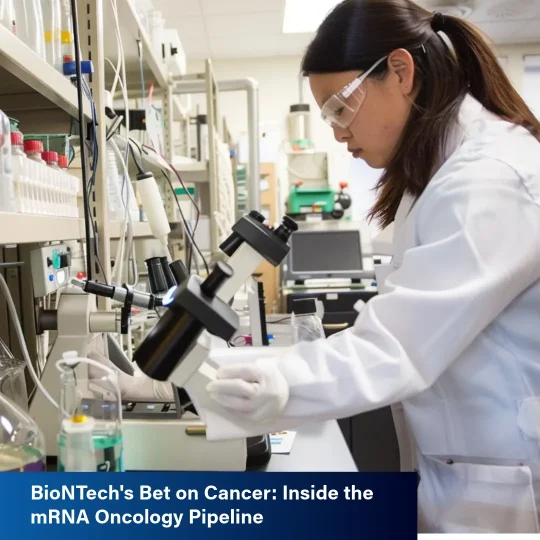
BioNTech’s Bet on Cancer: Inside the mRNA Oncology Pipeline
For many people, BioNTech became a household name during the COVID-19 pandemic.
Its partnership with Pfizer delivered one of the first successful mRNA vaccines against SARS-CoV-2, demonstrating not only the speed of modern biotechnology but also the immense potential of messenger RNA (mRNA) as a therapeutic platform.
Yet long before the pandemic, BioNTech's primary mission was not infectious disease.
It was cancer.
Founded in 2008 by scientists and physicians who believed that the future of medicine would be personalised and data-driven, BioNTech spent years building technologies designed to harness the immune system to fight cancer. While its COVID-19 vaccine generated billions of dollars in revenue and brought global recognition, the company's long-term vision remains firmly focused on oncology.
Today, BioNTech is investing heavily in one of the most ambitious cancer pipelines in biotechnology. Its goal is nothing less than transforming cancer treatment through personalised vaccines, next-generation immunotherapies, cell therapies, antibody technologies and artificial intelligence-driven drug discovery.
As the oncology landscape evolves, BioNTech's success—or failure—could help determine whether mRNA becomes one of the defining cancer treatment platforms of the twenty-first century.
From Pandemic Leader to Oncology Pioneer
The extraordinary success of the COVID-19 vaccine created a unique opportunity for BioNTech.
Unlike many biotechnology companies, which must continually raise capital to fund research, BioNTech emerged from the pandemic with substantial financial resources, global manufacturing capabilities and extensive expertise in mRNA development.
Rather than pivoting away from its original mission, the company has redirected much of that strength back into oncology.
Its strategy is built on a simple but powerful concept:
Every cancer is biologically unique.
If therapies can be tailored to the specific molecular characteristics of an individual's tumour, treatment outcomes may improve significantly.
This idea sits at the centre of BioNTech's personalised cancer vaccine platform.
Why mRNA Could Change Cancer Treatment
Traditional cancer therapies often target broad disease categories.
For example, two patients with lung cancer may receive similar treatments despite having very different tumour biology.
BioNTech's approach seeks to personalise treatment at a much deeper level.
Messenger RNA acts as a set of biological instructions that tells cells which proteins to produce.
In the context of cancer, researchers can design mRNA molecules that encode tumour-specific antigens—unique markers found on cancer cells.
Once administered to a patient, the mRNA instructs cells to produce these antigens, effectively teaching the immune system to recognise and attack cancer.
The concept resembles vaccination, but instead of preventing infectious disease, the goal is to direct immune responses against an existing tumour.
If successful, this strategy could offer:
- Highly personalised treatment
- Improved immune targeting
- Reduced damage to healthy tissue
- Greater flexibility across cancer types
- Faster development compared with conventional therapies
These potential advantages explain why mRNA oncology has become one of the most closely watched areas in biotechnology.
Personalised Cancer Vaccines
Perhaps the most exciting component of BioNTech's oncology portfolio is its personalised cancer vaccine programme.
The process typically involves:
- Sequencing a patient's tumour.
- Identifying unique mutations known as neoantigens.
- Designing an mRNA vaccine tailored specifically to those mutations.
- Administering the vaccine to stimulate a targeted immune response.
This highly individualised approach represents a major departure from conventional oncology.
Rather than creating a single therapy for all patients, BioNTech aims to create customised treatments based on each patient's tumour biology.
Advances in genomic sequencing, computational biology and manufacturing technology have made this vision increasingly feasible.
Several clinical programmes are currently evaluating whether personalised cancer vaccines can improve outcomes in cancers such as melanoma, colorectal cancer and other solid tumours.
Combining mRNA with Immunotherapy
Cancer vaccines are unlikely to operate in isolation.
BioNTech believes the greatest impact may come from combining mRNA technologies with existing immunotherapies.
Immune checkpoint inhibitors have already transformed oncology by helping the immune system recognise cancer cells.
However, many patients do not respond adequately to these treatments.
One challenge is that the immune system may struggle to identify tumour cells in the first place.
Personalised mRNA vaccines could potentially address this problem by generating stronger tumour-specific immune responses.
The combination of:
- Cancer vaccines
- Checkpoint inhibitors
- Immune-modulating therapies
may create synergistic effects that improve treatment efficacy.
This combination strategy is becoming a central theme throughout modern oncology research.
Beyond mRNA: A Diversified Oncology Platform
Although BioNTech is best known for mRNA, the company is far from a single-technology organisation.
Over the past several years, it has expanded into multiple therapeutic modalities.
These include:
Cell Therapies
BioNTech is developing cell-based approaches designed to enhance immune responses against cancer.
These programmes seek to build upon lessons learned from CAR-T therapies while addressing limitations such as tumour resistance and manufacturing complexity.
Antibody-Based Therapies
The company is also investing heavily in antibody technologies.
Antibodies remain one of the most successful classes of oncology therapeutics and continue to generate significant clinical and commercial value.
BioNTech's pipeline includes innovative antibody formats designed to improve targeting and immune activation.
Bispecific Antibodies
Bispecific antibodies are engineered to bind two targets simultaneously.
This approach may improve the ability of immune cells to identify and destroy cancer cells.
Many industry observers consider bispecifics one of the fastest-growing segments of oncology development.
Antibody-Drug Conjugates
Antibody-drug conjugates (ADCs) combine the targeting precision of antibodies with potent anti-cancer payloads.
The field has attracted significant industry investment due to its ability to selectively deliver treatments to tumours while reducing systemic toxicity.
BioNTech has increasingly expanded its presence in this rapidly growing area.
Artificial Intelligence and Cancer Research
Like many biotechnology leaders, BioNTech is investing in artificial intelligence to accelerate oncology research.
AI applications include:
- Target discovery
- Biomarker identification
- Patient selection
- Clinical trial optimisation
- Protein design
- Drug development
The combination of AI and mRNA is particularly powerful because personalised vaccines generate enormous amounts of genomic and biological data.
Advanced computational systems help researchers identify which tumour mutations are most likely to generate effective immune responses.
As AI capabilities continue to improve, they may become an essential component of personalised cancer treatment development.
The Competitive Landscape
BioNTech is not alone in pursuing mRNA oncology.
Several biotechnology companies are developing similar technologies.
Competition is emerging across areas such as:
- Personalised cancer vaccines
- RNA therapeutics
- Immuno-oncology
- Cell therapies
- Neoantigen targeting
However, BioNTech possesses several advantages.
These include:
- Extensive mRNA expertise
- Global manufacturing infrastructure
- Strong financial resources
- Established regulatory experience
- Advanced genomic capabilities
The revenue generated during the pandemic has provided the company with an unusually strong foundation from which to pursue long-term oncology innovation.
Challenges Ahead
Despite the excitement surrounding mRNA cancer therapies, significant challenges remain.
Biological Complexity
Cancer is highly heterogeneous.
Tumours evolve over time, creating ongoing challenges for targeted therapies.
Manufacturing Personalised Treatments
Customised vaccines require sophisticated manufacturing systems capable of producing patient-specific products quickly and reliably.
Clinical Validation
The ultimate test remains clinical outcomes.
Researchers must demonstrate that personalised cancer vaccines deliver meaningful improvements in survival and quality of life.
Regulatory Considerations
Highly personalised therapies may require new regulatory frameworks and manufacturing approaches.
While progress has been encouraging, substantial work remains before these technologies become routine clinical practice.
What Success Could Mean for Oncology
If BioNTech's strategy succeeds, the implications could be profound.
Future cancer treatment may increasingly involve:
- Genomic sequencing
- Personalised vaccine design
- AI-assisted treatment planning
- Combination immunotherapies
- Individualised treatment pathways
Such an approach would represent a fundamental shift away from traditional population-based oncology models.
Instead, treatments could be tailored to the unique biology of each patient's disease.
This vision aligns closely with the broader movement toward precision medicine that is reshaping healthcare.
Looking Ahead
The COVID-19 pandemic demonstrated that mRNA technology could be developed, manufactured and deployed at unprecedented speed and scale. Yet for BioNTech, the pandemic may ultimately be remembered not as the destination, but as the catalyst.
The company's long-term ambition remains centred on cancer.
By combining mRNA platforms, personalised vaccines, immunotherapy, antibody technologies, cell therapies and artificial intelligence, BioNTech is building one of the most ambitious oncology pipelines in the biotechnology industry.
The scientific, manufacturing and regulatory challenges remain significant. However, the potential rewards are equally substantial.
If personalised mRNA cancer therapies can consistently improve outcomes for patients, they may redefine how oncology is practiced for decades to come.
For investors, researchers, recruiters and biotechnology professionals, BioNTech's oncology programme represents more than a pipeline. It is a test of whether the promise of personalised medicine can finally be realised at scale.
And if that vision becomes reality, the company's greatest contribution to medicine may still lie ahead.